
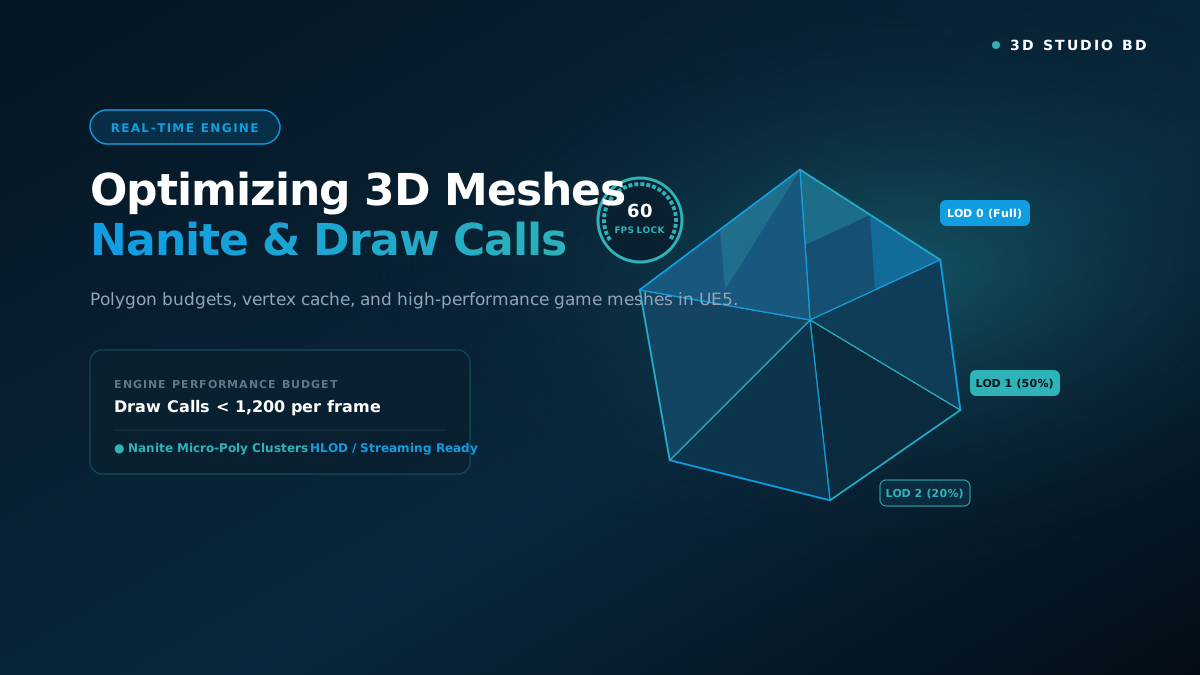
Real-Time Performance in the Age of Unreal Engine 5
With the introduction of Nanite in Unreal Engine 5, many novice artists assumed polygon budgets were completely obsolete. While Nanite virtualizes geometry and eliminates manual LOD creation for static meshes, pipeline discipline is more important than ever.
1. Nanite Limitations You Must Know
- Non-Static Geometry: Skinned skeletal meshes (characters, creatures, deforming foliage) do not benefit from standard static Nanite virtualization.
- Overdraw & Transparency: Masked opacity materials (foliage leaves, chainlink fences) still carry heavy pixel shader costs.
- Disk & Memory Footprint: Importing raw 20-million polygon ZBrush sculpts without cleanup will bloat game download sizes to hundreds of gigabytes.
2. Vertex Cache & Draw Call Consolidation
Draw calls represent CPU overhead communicating with the GPU:
- Combine multiple small prop meshes sharing the same material into consolidated batches.
- Use Material Instances over unique master materials to maximize GPU state caching.
- Align UV islands along quad strips to prevent vertex duplication along seams.
3. Practical Optimization Checklist
- Check mesh for non-manifold edges and zero-area faces before export.
- Merge small repetitive props using Unreal Hierarchical Instanced Static Meshes (HISM).
- Calibrate collision hulls (use simple primitives rather than complex convex hulls).

Discussion & Comments (2)
Leave a comment ↓