
The Paradigm Shift in Hard-Surface Modeling
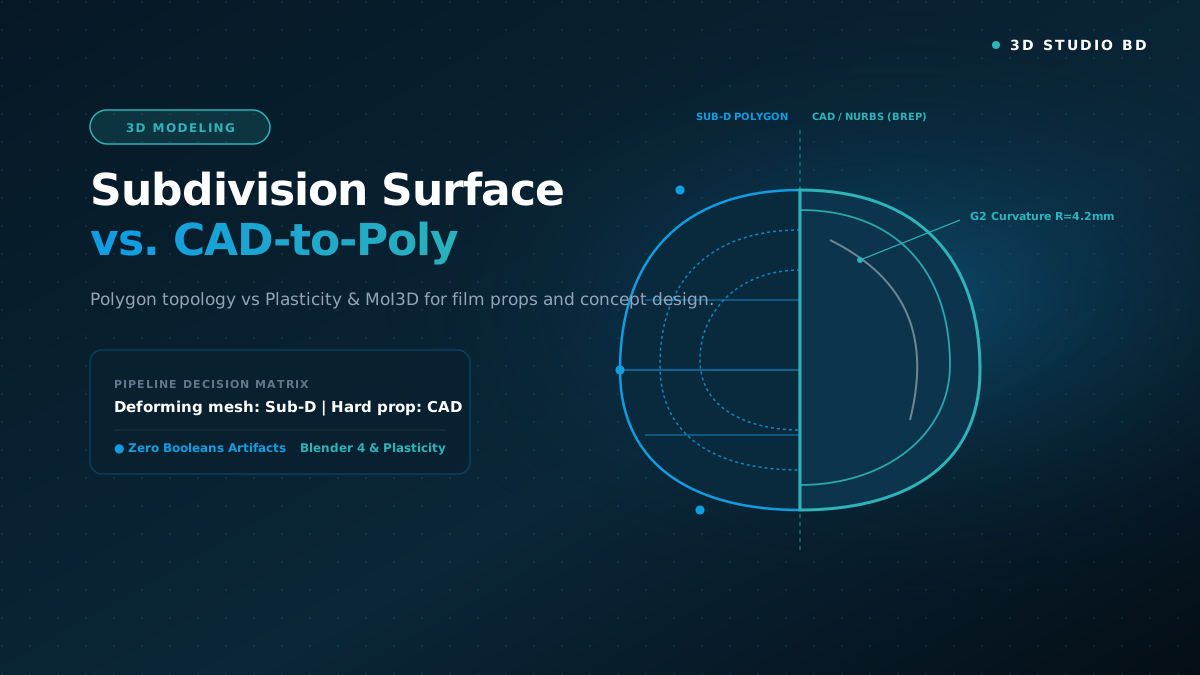
For over two decades, Subdivision Surface (Sub-D) modeling was the undisputed king of hard-surface 3D production. Artists spent hundreds of hours routing holding edges, redirecting edge loops, and massaging corner poles to maintain G2 curvature under subdivision.
Today, modern CAD tools like Plasticity and MoI3D have rewritten production rules for concept design, weapons, vehicles, and mechanical props.
When to Choose Sub-D Modeling
- Deforming Geometry: If your hard-surface mesh bends, twists, or animates (e.g., robotic joints, character armor plates attached to rigging).
- VFX Close-up Rendering: When infinite smoothing at render time via OpenSubdiv is required for extreme macro cinematic shots.
- Precision UV Unwrapping: Clean quad topology is trivial to unwrap without distortion or irregular triangle seams.
When to Choose CAD-to-Poly (NURBS / BREP)
- Concept Prototyping Speed: Fillet and boolean without ever worrying about topology artifacts or pinching.
- Complex Mechanical Tolerances: Perfect radii, G1/G2 tangent blends, and exact real-world dimensions.
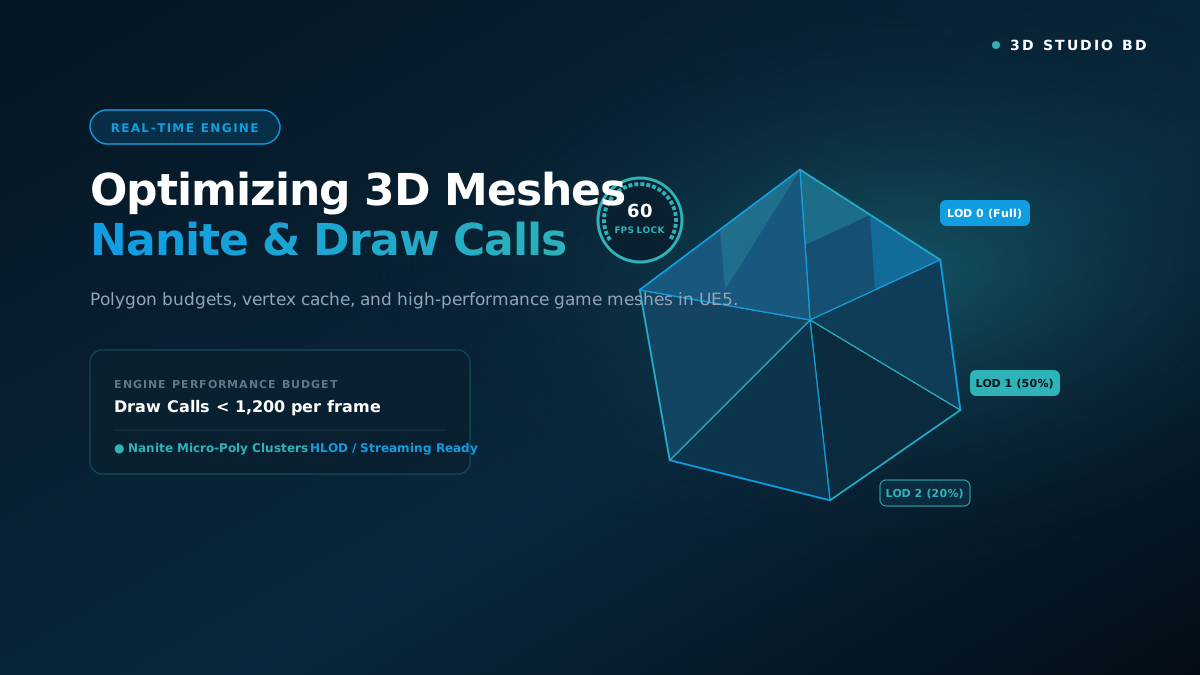
- Automated Meshing: Export clean quad/tri meshes directly using modern remeshers or high-density decimation for Nanite.
The Hybrid Studio Pipeline
Leading game and film studios now utilize a hybrid pipeline: sketch and resolve hard-surface forms in CAD, export high-poly meshes for baking, and retopologize only the low-poly deforming silhouette.
Discussion & Comments (2)
Leave a comment ↓