
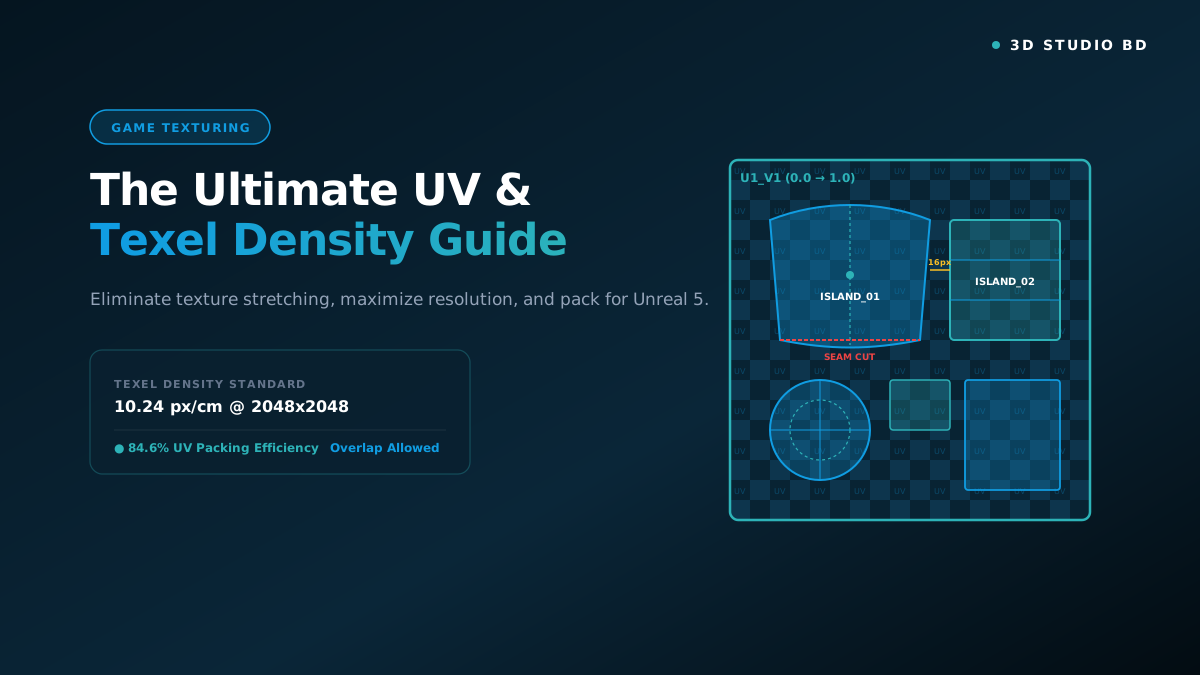
Why Texel Density is the Foundation of Visual Consistency
Have you ever loaded multiple 3D assets into Unreal Engine or Unity, only to notice that a tiny wooden chair looks razor-sharp while the adjacent wall appears blurry and pixelated? That visual clash is caused by inconsistent Texel Density (TD).
What is Texel Density?
Texel density measures how many texture pixels (texels) are mapped to a unit of real-world 3D geometry—typically measured in pixels per meter (px/m) or pixels per centimeter (px/cm).
Standard Game Benchmarks
- First-Person Weapons & Hero Props:
20.48 px/cm(4K texture per hero asset) - Third-Person Character & Vehicles:
10.24 px/cm(2K–4K) - Environment Architecture & Modular Kits:
5.12 px/cm(tileable trim sheets)
Top 4 Rules for Clean UV Seam Placement
- Hide Seams in Natural Creases: Place cuts where natural material breaks occur (welds, fabric stitching, panel seams).
- Sharp Angle Rule (>45°): Any hard edge requiring a smoothing group break must have a corresponding UV seam to prevent normal map bake bleeding.
- Straighten Rectangular Islands: Straightening cylinder sleeves and strap strips drastically increases packing efficiency and eliminates stair-stepped aliasing.
- Maintain Uniform Scale: Never scale one UV island independently unless creating a hero decal with intentional higher priority.



Discussion & Comments (2)
Leave a comment ↓